
Last Updated: October 9, 2026
Quick Answer
A fully produced audio ad combines a professional voice performance, a music bed, and a final mix that meets the loudness specs of your target platform. You can order voice talent and music production together at VoiceJungle—each script or tag is submitted as a separate order. The result is a broadcast-ready file you can hand straight to your media buyer. Most :30 and :60 spots cost $145 fully produced.
In this guide
What "Fully Produced" Actually Means
When an ad buyer or traffic department asks for a "produced spot," they mean a finished, mixed audio file—not a raw voice read. The voice alone is a starting point. A fully produced ad layers a voice performance, a music bed, any sound design, and a final mix that hits the loudness spec your station, network, or streaming platform requires.
That distinction matters because a raw voice file handed to a station will either be rejected or mixed in-house—often poorly, and at your cost. A produced spot arrives ready to air. It sounds like it belongs next to the other commercials on the break, not like someone recorded it in a closet and hoped for the best.
This page covers the audio ad production workflow from top to bottom: what goes into each layer, how lengths and tags work, the loudness numbers your engineer needs to hit, and exactly how to order voice plus production at VoiceJungle in one pass.
Section summary: A produced spot is a finished, platform-ready file with voice, music, and mix—not just a voice read.
The Four Elements of a Produced Spot
1. Voice Performance
This is the foundation. The voice actor delivers your script with the right tone, pacing, and energy for your brand. Every voice actor on VoiceJungle is fully vetted for ability and studio quality, so you're starting from a clean, professional recording.
For scripts under one minute, you'll typically receive two to three reads to choose from. Longer scripts receive one read. That range of reads is part of the base price—no extra charge.
2. Music Bed
A music bed runs underneath the voice, sets the emotional tone, and fills the space between words. For a 30-second ad, the music is usually mixed so it's audible in the intro, ducks under the voice during the body copy, and comes back up briefly under the tag or call to action.
The music doesn't have to be elaborate. Sparse, understated beds often work better than busy ones because they don't compete with the message.
3. Mix
The mix is where voice and music become one cohesive file. A good mix keeps the voice intelligible at all points, balances the emotional energy of the music, and—critically—lands at the correct integrated loudness level for your distribution outlet. More on that in a moment.
4. Mastered Output File
The final deliverable is a mastered audio file in the format your station or platform accepts, at the correct loudness, sample rate, and bit rate. Getting this right before you submit saves you from trafficking delays and re-submissions.
Section summary: Voice, music bed, final mix, and a spec-compliant output file are the four non-negotiable layers of a produced spot.
Ad Lengths and Versions: 15, 30, 60, and Tags
Most audio advertising runs in a small set of standard durations. Knowing which lengths you need before you start production keeps your project organized and your budget predictable.
Spotify accepts standard audio ad creative up to 30 seconds, with long-form audio ads of up to 60 seconds offered in select markets for Direct IO and Programmatic Guaranteed campaigns. See the chart below for word counts of common ad lengths on Spotify and other broadcast and streaming platforms. You can learn more about common word counts and other script recommendations in our article Tips for Writing a Voiceover Script. Running a campaign? See our guide to political voiceover for ad timelines and AI-disclosure rules.
|
Length |
Common use |
Approximate word count |
|---|---|---|
|
:60 |
AM/FM radio, long-form streaming, podcast mid-rolls |
~150 words |
|
:30 |
AM/FM radio, streaming pre-rolls, podcast pre-rolls |
~75 words |
|
:15 |
Digital pre-rolls, companion tags, social audio |
~35–40 words |
|
:06-:10 Tag |
Price updates, location callouts, seasonal swaps |
5–20 words |
Actual count depends on pacing and delivery style - always read your script aloud before you finalize.
Tags are short add-ons (usually a different call to action, price, location, or seasonal line) appended to an existing spot. A common workflow: record one :30 body, then record three tags (spring sale, summer sale, fall sale) so you can swap them in without re-producing the whole spot.
At VoiceJungle, each script version and each tag must be submitted as a separate order. That keeps production clean and revision tracking straightforward.
Section summary: Plan your lengths and tags before you order. Each version is a separate job, not an appendix to another. VoiceJungle recommends ~150 words for a :60 script.
Loudness Targets by Outlet
Streaming platforms use loudness normalization to deliver a consistent listening experience, adjusting playback level to a standardized target expressed in LUFS (Loudness Units Full Scale). Streaming platforms use LUFS to normalize playback so listeners don't have to constantly adjust their volume between songs. (danmurtagh.com) For audio advertising specifically, the targets vary by outlet, and delivering off-spec audio to a traffic department can trigger a re-submission cycle that delays your campaign launch.
Here are the key specs your production engineer needs to know:
|
Outlet |
Loudness target |
True Peak limit |
Source |
|---|---|---|---|
|
Spotify audio ads |
−16 LUFS (±1.5) |
−2.0 dBTP |
|
|
Streaming/digital podcast (general) |
−16 LUFS |
−2.0 dBTP |
|
|
U.S. broadcast TV (ATSC A/85 / CALM Act) |
−24 LKFS |
−2 dBTP |
|
|
European broadcast (EBU R128) |
−23 LUFS |
−1 dBTP |
Spotify requires an integrated average loudness of −16 LUFS (±1.5 LUFS) and a True Peak limit of −2.0 dBTP, which ensures the ad volume is consistent with content and throughout the ad itself. (adshelp.spotify.com)
FCC rules require commercials to have the same average volume as the programs they accompany. Under the Commercial Advertisement Loudness Mitigation (CALM) Act, which went into effect on December 13, 2012, the rules require TV stations, cable operators, satellite TV providers, and other multichannel video program distributors to apply the ATSC A/85 Recommended Practice to commercial advertisements they transmit to viewers. (fcc.gov) ATSC A/85 targets −24 LKFS with a true peak maximum of −2 dBTP. (criticallisteninglab.com) The CALM Act applies only to commercials aired on television—it does not apply to radio commercials or commercials aired on the internet or via streaming services. (This is general regulatory information, not legal advice. Confirm compliance requirements with qualified counsel.)
EBU R128 recommends normalizing audio at −23 LUFS (±1 LU for live programmes), measured with a relative gate at −10 LU. (tech.ebu.ch) It also sets a true peak maximum of −1 dBTP. (criticallisteninglab.com)
Always confirm the loudness spec with your station, network, or platform before mixing. Delivering off-spec audio to a traffic department risks a re-submission cycle that delays your campaign launch.
Section summary: Always confirm the loudness spec with your outlet before mixing. Spotify audio ads target −16 LUFS; U.S. broadcast television targets −24 LKFS under the CALM Act (TV only—not radio or streaming). European broadcast follows EBU R128 at −23 LUFS.
Music Options at VoiceJungle
Once your voice is recorded, VoiceJungle's audio engineers can handle the music mix so you get a finished, broadcast-ready file without sourcing a separate production house.
You have two options:
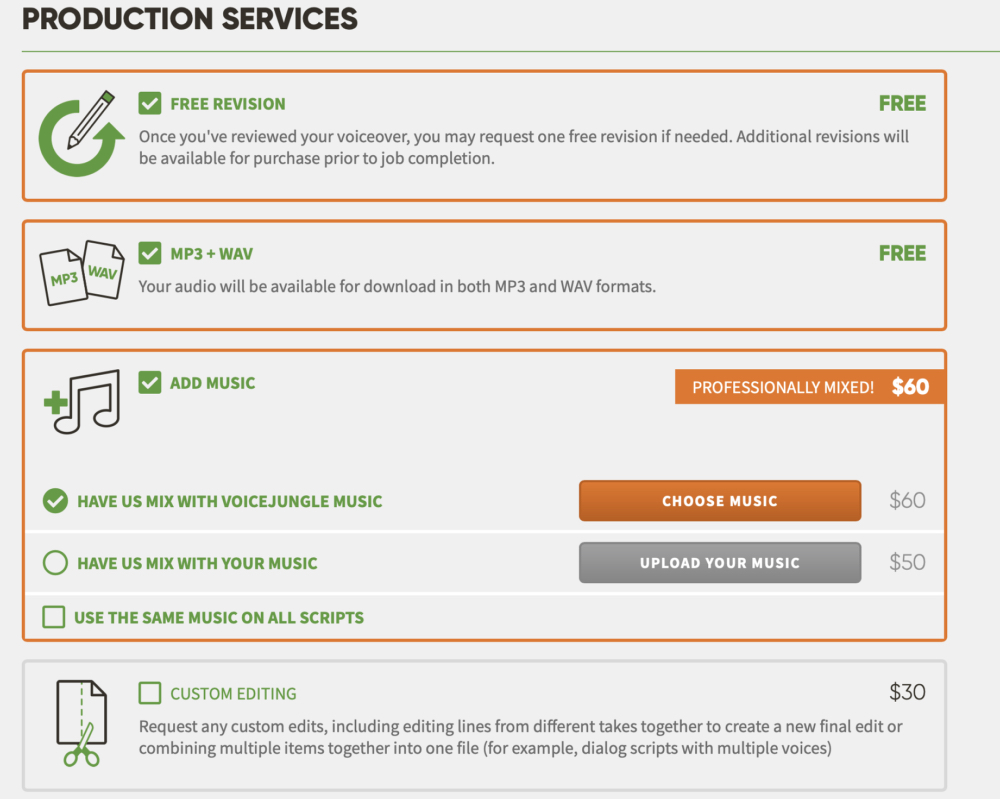
Option 1: Royalty-free library track mix - $60
VoiceJungle mixes your voiceover with a track from our royalty-free music library. The engineer selects a track that fits the tone and pace of your script, ducks it appropriately under the voice, and delivers a finished file. This is the fastest path to a fully produced spot.
Option 2: Upload your own music/jingle mix - $50
If your brand has a signature jingle or licensed track, send it over. VoiceJungle engineers mix your music with the voice recording for $50. You stay on brand; we handle the mix.
In both cases, the output is a clean, mixed file ready for trafficking. If your outlet has a strict loudness spec (see the table above), mention it in your order notes so the engineer can adjust the final level accordingly.
Visit our page on Music and Production for full details on what's included.
What a produced spot costs
Most :30 and :60 spots come to $145: the $85 voice minimum, which covers scripts from 31 to about 220 words, plus the $60 library music mix. That’s the same flat price you’ll see on our audio ads page, and it includes a full buyout with no licensing restrictions. Short tags of 30 words or fewer come to $115 with a library mix. If you bring your own music, subtract $10. RUSH delivery on the voice adds $30 per script.
Section summary: Add a $60 library-track mix or a $50 bring-your-own-music mix to any voice order at VoiceJungle for a finished, produced spot.
How to Order Voice + Production at VoiceJungle
The ordering flow is straightforward. Here's the full sequence:
-
Choose your voice talent using filters for language, gender, style, and delivery speed. Listen to demos before you add anyone to your cart. For spots needed quickly, look for talent marked RUSH (delivery in 2 hours or less for scripts up to 300 words). Once you've found your talent, click Select to start your order.
-
Upload your script. Each audio ad script should be uploaded as a separate item. More on that below.
-
Add music production. Select the library mix ($60) or bring-your-own mix ($50) in the production services section of your order.
-
Make notes for editing. Here's where you can make your note your loudness spec. If you know the outlet (Spotify, terrestrial radio, podcast network), include the target LUFS in the order notes field. NOTE: after you've approved your voiceover, you'll have another opportunity to add or update notes for editing, including specifying which take you want to use or how the music should be edited.
-
Submit you order. Once the talent records your voiceover, you'll have the opprtunity to request revisions before approving. Then, your order will be sent to our production staff to finish your mix with your chosen music. You'll be notified by email when your mix is finished and ready for download. Orders auto-approve 14 days after audio upload if you take no action.
Pricing: VoiceJungle charges 38 cents per word. The minimum for scripts up to 30 words is $55; for scripts over 30 words, the minimum is $85. Every order includes a full media buyout - any use, forever, with no residuals or renewal fees.
One free revision is included per project for any reason, including script changes of up to 25 words. If the talent makes an error, it's fixed at no charge, always.
See our Rates Page for full details, or run a quick estimate with our handy Price Calculator.
Section summary: Browse, select, add production, note your spec, and submit. The process is self-serve from first listen to final download.
Submitting Multiple Scripts and Tags
This is the part that trips up some first-time buyers: at VoiceJungle, each script and each tag is submitted as its own separate order. That includes:
-
Each length variation (a :60 and a :30 version of the same campaign are two orders)
-
Each tag (a price-point tag and a location tag are two orders)
-
Any revised or seasonal swap scripts
Separate orders keeps revision tracking clean, ensures each read gets its own record, and makes it easy to approve or revise individual pieces without touching the rest of the campaign. If you have three scripts and two tags, you'll have five line items. Budget accordingly.
Practical example:
You're running a spring promotion across streaming and terrestrial radio. You need:
| Version | Word count | Voice cost | Music mix | Produced total |
|---|---|---|---|---|
| :60 brand spot | ~150 words | $85 min | $60 | $145 |
| :30 edit | ~75 words | $85 min | $60 | $145 |
| :15 digital pre-roll | ~38 words | $85 min | $60 | $145 |
| "Ends April 30th" tag | 12 words | $55 min | — | $55 |
| "Shop online at…" tag | 10 words | $55 min | — | $55 |
Five separate orders, $545 total. The :60, :30, and :15 get the library music mix; the shorter versions are cut from the produced files.
For the Spanish-language version of any of these, see our guide to Spanish-language audio ads for U.S. Hispanic markets. Translation is available at $60 per 150 words, and you approve the translation before the talent records.
Section summary: Submit each script and tag as its own order. Five versions means five orders—budget and plan accordingly before you start.
Frequently Asked Questions
What file format will I receive for my produced audio ad?
The voice recording is delivered as a high-quality audio file (WAV & MP3). When you add music production, the engineer delivers a mixed file in both file formats as well. Spotify requires a sample rate of 44.1 kHz and a bit rate of 192 kbps for ad trafficking. Specify your preferred format and any traffic requirements in the order notes field, and the engineer will accommodate them.
Does VoiceJungle master my ad to a specific LUFS target?
By default, the production team mixes to a professional standard, but if you need a specific integrated loudness (for example, −16 LUFS for Spotify audio ads or −24 LKFS for U.S. broadcast television under ATSC A/85) note the target in your order. Always confirm the required spec with your station or platform before submitting your order.
Can I use the same voice talent for my :60 and all my tags?
Yes. Add the same talent to multiple items in your order. Consistency across spot lengths and tags is easy to plan. Just make sure all versions are submitted before recording begins if you need them delivered together.
What if I want a :30 and a :15 cut of the same spot?
Each is a separate order at VoiceJungle. If the :15 is a straight lift of the last 15 seconds of the :30, you still submit it as its own script. The per-word rate applies, with the $55 minimum for scripts up to 30 words.
Do produced spots qualify for RUSH delivery?
RUSH delivery is available on the voice recording portion - talent marked RUSH can deliver scripts of 300 words or fewer in 2 hours or less for +$30 per script, Monday–Friday 9 am–7 pm Eastern. Music production and mixing add time beyond the voice turnaround. RUSH is not available on orders that include translation. Contact VoiceJungle before ordering if your deadline is extremely tight.
What is the VoiceJungle Guarantee?
Every order is backed by the VoiceJungle Guarantee: if the voiceover is unsatisfactory, you can receive a full refund per the Guarantee and Revision Policy. Visit our FAQ page for more details.
Can I write my own ad script, or do I need a copywriter?
You write your own script and paste it into the order form. If need want help with structure before you order, see Tips for Writing a Voiceover Script for practical advice and word-count guidance.
Ready to Build Your Produced Spot?
Browse vetted voice talent on our Voices Page, listen to demos, and add production in the same order. Each voice actor has been reviewed for ability and studio quality. Every order includes a full media buyout - any use, forever. Most produced :30 and :60 spots come to $145 all in: voice plus a library music mix, or bring your own music for $10 less.
Browse voice talent and get started!