

Last Updated: Nov 3, 2026
Quick Answer
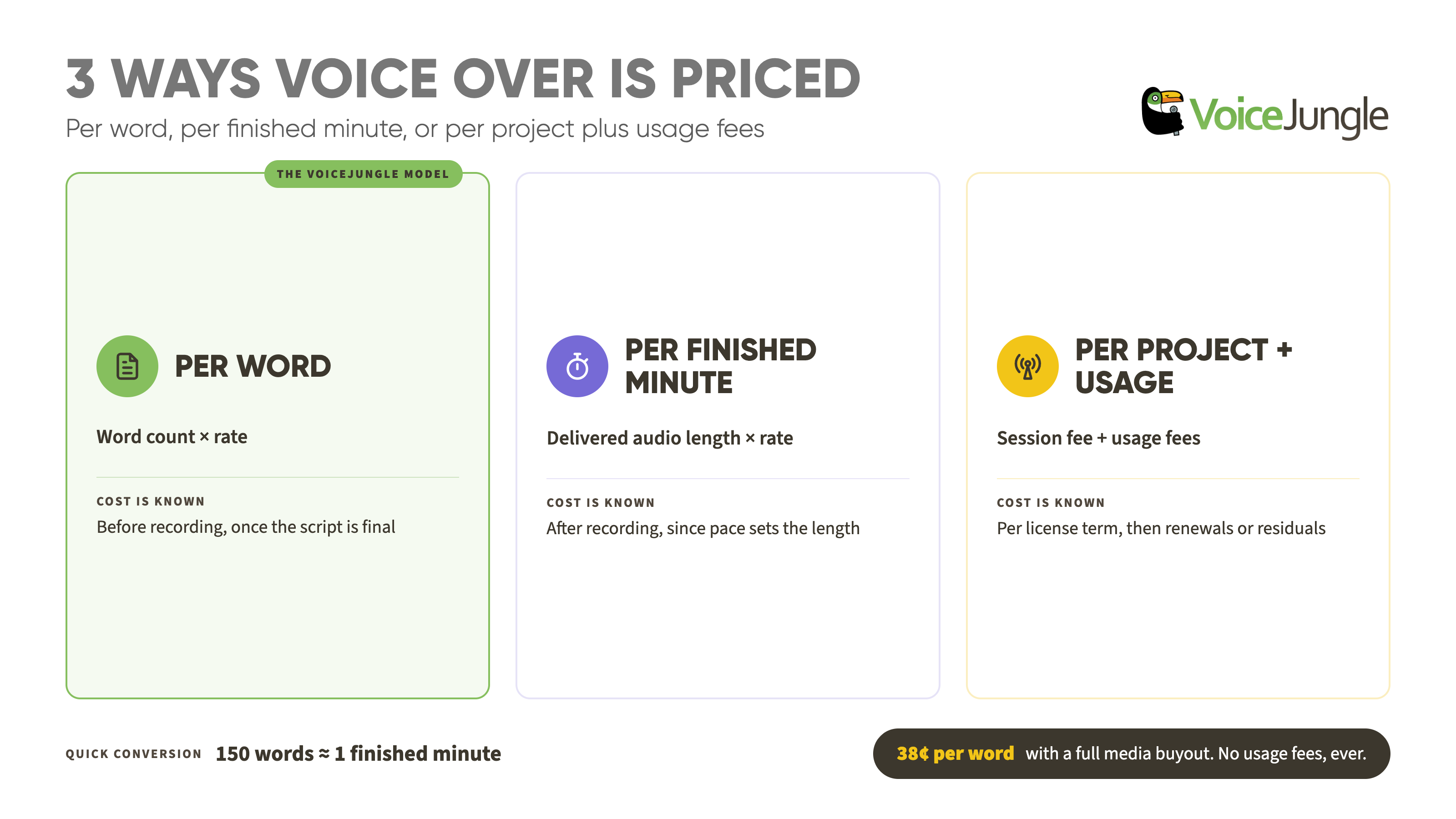
Voice over pricing comes in three main flavors - per word, per finished minute, and per project plus usage fees. Each model suits different project types, and they're not always apples-to-apples comparisons. At VoiceJungle, every job is quoted at a simple 38 cents per word with a full media buyout included - no usage fees ever.
In this guide
Why Voice Over Pricing Varies So Much
If you've ever requested a voiceover quote and gotten back a number that seemed to come out of thin air, you're not alone. There is no single voiceover rate, because the same 60 seconds of audio can be worth $50 or $5,000 depending on how it will be used.
Three variables drive almost every quote you'll receive:
-
Script length: measured in words or finished running time
-
Project type: a 30-second radio spot and a 60-minute eLearning course are categorically different
-
Usage rights: where the recording plays, for how long, and in how many markets
Understanding the pricing model behind any quote is the first step to knowing whether you're getting a fair deal. Head over to the How Much Does a Voiceover Cost? guide for the full picture, then come back here for the per-word vs. per-minute breakdown.
Section summary: Voice over prices aren't arbitrary. They're driven by length, content type, and usage rights. Knowing which model a vendor uses tells you a lot about what you're really buying.
Model 1: Per Word - the Most Transparent Rate
Per-word pricing means each word is priced separately - transparent and predictable. You know your cost the moment your script is finalized, before a single line is recorded.
Per word is standard for scripts where length is known up front, like eLearning and corporate narration. It works well for any project where the script is essentially locked before production begins.
How VoiceJungle prices it: Every job on VoiceJungle is quoted at 38 cents per word—a single, published rate across all talent on the platform. There's a minimum of $55 for scripts up to 30 words, and $85 for scripts over 30 words. You can run the numbers yourself at any time with our price calculator.
The per-word model has one important practical note: for advertising, each script or tag must be submitted as a separate order, because each one is its own deliverable.
Section summary: Per-word pricing is the easiest model to understand and verify. You count the words in your script, multiply by the rate, and that's your cost.
Model 2: Per Finished Minute (and Per Finished Hour)
Narration is often priced by the length of the delivered audio, not the time you spent recording. This model charges you based on the running time of the finished audio—not the length of your script, and not the time the talent spent in the booth.
This model is common in two contexts:
-
Corporate and eLearning narration: Standard corporate and eLearning narration runs about $180 to $250 per finished minute, and specialized medical or technical narration runs about $220 to $300.
-
Audiobooks: Per-finished-hour (PFH) pricing dominates in audiobooks, at $200–$500 per finished hour.
The challenge with PFM pricing is that the delivered length depends on the talent's speaking pace, which you don't fully control. A slower, more deliberate delivery style produces more finished minutes and a higher bill, even from the same script. This is why buyers who have a firm word count often prefer the per-word model.
Section summary: Per finished minute prices the output, not the input. That's fair for both parties in long-form narration, but it introduces a variable that per-word pricing removes entirely.
Model 3: Per Project + Usage Fees
This is the model most buyers encounter when working with advertising—radio spots, TV commercials, and digital ad campaigns. A flat session fee covers the recording itself; separate usage fees cover where and how long the audio runs.
SAG-AFTRA commercial pay has two layers. The first is the session fee, which compensates you for the time spent performing. The second is the use fee, which compensates the talent every time the commercial is broadcast, streamed, or otherwise distributed (SAG/AFTRA).
The usage fee grants you the legal right to broadcast, distribute, or publish the voice actor's performance. A common misconception is that paying the session fee means you can use the voiceover indefinitely, anywhere you wish.
For union commercial work, rates are set by contract. Session fees and usage rates vary by use category, platform, and cycle length; always confirm current minimums directly at sagaftra.org.
Non-union commercial work is more flexible, but usage fees still apply in most cases. Commercials are priced by reach, not by length. Local radio might be $150–$300; national TV spots can range from $2,000 to $20,000+ depending on usage (SAG/AFTRA).
Section summary: The per-project + usage model is standard for broadcast advertising because the commercial value of a recording scales with its reach, not its length. It's the most complex model for buyers to evaluate and track over time.
The Conversion Math: Words to Minutes
When you're comparing a per-word quote to a per-finished-minute quote, you need one number: the average speaking rate for voiceover.
According to the National Center for Voice and Speech, the average conversation rate for English speakers in the United States is about 150 wpm (VirtualSpeech, 2026). Audiobook narration runs between 150–160 wpm, which is the upper range that people comfortably hear and vocalize words. For planning purposes, 150 words per minute is the standard working estimate used across the voiceover industry.
Here's the conversion table:
|
Script Length |
~Running Time |
VoiceJungle Cost (38¢/word) |
|---|---|---|
|
75 words |
~30 seconds |
$85.00 (minimum applies) |
|
150 words |
~1 minute |
$85.00 (minimum applies) |
|
300 words |
~2 minutes |
$114.00 |
|
500 words |
~3.3 minutes |
$190.00 |
|
750 words |
~5 minutes |
$285.00 |
|
1,500 words |
~10 minutes |
$570.00 |
|
3,000 words |
~20 minutes |
$1,140.00 |
Note on pace: Commercial announcers tend to speak faster than conversational narrators to fit more information into a short spot. If you're writing a :30 radio spot, assume 65-80 words maximum; for a :60 spot, 130-160 words. Fast commercial reads can push toward 180 words per minute.
Section summary: 150 words ≈ 1 finished minute. That single conversion lets you translate any per-word rate into an effective per-minute rate and compare it to other vendors in a single step.
Worked Examples with Real Numbers
Example 1: Short explainer video (90 seconds)
You've written a 225-word script for a product explainer.
|
Calculation |
Result |
|---|---|
|
VoiceJungle (38¢ × 225 words) |
$85.50 |
|
Mid-tier PFM quote ($200/finished minute × 1.5 min) |
$300.00 |
|
Low-end PFM quote ($30/finished minute × 1.5 min) |
$45.00 (likely a newer, unvetted voice) |
Example 2: eLearning module (10 minutes / ~1,500 words)
You need a polished narrator for a corporate compliance course.
|
Calculation |
Result |
|---|---|
|
VoiceJungle (38¢ × 1,500 words) |
$570.00 |
|
Corporate narration PFM at $200/min × 10 min |
$2,000.00 |
|
Budget freelancer at $0.10/word × 1,500 |
$150.00 (studio quality and rights unverified) |
Example 3: 30-second radio ad
You have a 75-word script you want to run on local radio for three months.
|
Scenario |
Cost |
Notes |
|---|---|---|
|
VoiceJungle (minimum, 75 words) |
$85.00 |
Full media buyout, any use, forever |
|
Non-union talent, local market quote |
$150–$300 |
Usually a short-term license only |
|
SAG-AFTRA union work |
Session fee + usage fees |
Residuals due per broadcast cycle; confirm current rates at sagaftra.org |
Section summary: Running real numbers side by side shows that per-word and per-minute quotes can land anywhere from close to wildly different. The key variable is always what's included in the price, especially usage rights.
Where Usage Fees Catch Buyers Off Guard in the Other Models
This is where many buyers get surprised well after the initial invoice.
In the per-project + usage model, the session fee is just the starting point. For example, if a client purchases the broadcast rights to use a voiceover in a local TV commercial and agrees the spot won't run for longer than six months—after six months, they'll need to renew the rights. These are renewal fees paid to the artist or agent. Every time your license period expires, you're back at the table paying again.
In the per-finished-minute model, usage rights terms vary widely and are embedded in each talent's contract. Voice over usage rights are the license granted by a voice actor allowing you to use their recorded performance for a specific purpose, within defined parameters, and for a set period. "Non-broadcast in perpetuity" is meaningfully different from "digital, one year, U.S. only"—and both can be buried in a quote that just says "PFM rate."
At VoiceJungle, every single job is a full media buyout. Any use. Any market size. Forever. That's built into the 38 cents per word—there are no usage multipliers, no renewal fees, no residuals.
Section summary: Usage fees are the hidden variable in most pricing models. Per-word pricing on a flat-buyout platform is the clearest way to see exactly what you're paying and what you own.
Choosing the Right Model for Your Project
Not every project fits the same pricing model. Here's a quick reference:
|
Project Type |
Best Pricing Model |
Why |
|---|---|---|
|
eLearning / training |
Per word |
Script is locked; length is predictable |
|
Corporate narration |
Per word or PFM |
Either works; per-word is easier to budget |
|
Audiobook |
Per finished hour |
Long-form; industry standard |
|
Per word or flat project |
Short, modular scripts |
|
|
Radio / TV commercial |
Per word or Per project + usage |
Reach matters more than length |
|
Explainer / social video |
Per word or flat |
Short, script-driven; flat buyout preferred |
|
Internal training / HR |
Per word |
Non-broadcast; buyout in perpetuity ideal |
For broadcast advertising specifically, the usage fee model exists for good reason—a national TV spot generates far more commercial value than a local web video read from the same script. For national broadcast campaigns or union talent, our sister company ProComm Voices quotes each project based on usage. That said, for the vast majority of business voiceover needs (eLearning, explainers, IVR, corporate video, on-hold messages, and more), a flat per-word rate with a full buyout is the cleanest, most budget-friendly structure available.
Check the VoiceJungle rates page for the full details on minimums and add-on services like rush delivery and music production.
Section summary: Match the pricing model to the project. For most non-broadcast business voiceover, per-word with a full buyout is the simplest, most cost-predictable choice.
Frequently Asked Questions
How many words are in a 1-minute voiceover?
According to the National Center for Voice and Speech, the average rate of conversational talk in the US is around 150 words per minute. That also holds true for most professional narration. Commercial announcers tend to speak faster, so for :30 and :60 ad spots, budget 75 and 150 words respectively. See our full breakdown on How Much Does a 1-Minute Voiceover Cost?
Is per-word or per-minute pricing cheaper?
It depends entirely on the speaking pace and the usage terms attached to each quote. A per-minute quote at $200/min sounds competitive for a 2-minute video—until you compare it to a per-word rate of 38 cents on a 300-word script ($114 at VoiceJungle) with a full buyout included. Always check what usage rights you're getting in both models.
What are residuals and do I have to pay them?
Residuals are ongoing payments made to voice talents based on the usage of their recordings. This model is common in projects where the recording is used extensively over time, such as in national advertising campaigns. They apply primarily to SAG-AFTRA commercial work. If you're using a non-union marketplace with a flat buyout, residuals are not part of the picture. VoiceJungle jobs carry no residuals or renewal fees of any kind.
Does market size affect how much I pay at VoiceJungle?
No. VoiceJungle's rate is 38 cents per word regardless of whether the recording runs locally, nationally, or globally. Market size doesn't affect the price because every job includes a full media buyout for any use, forever.
What's a "session fee" in voiceover pricing?
A session fee is the minimum an actor earns for a day of work on set or in a recording booth. In broadcast advertising, you typically pay a session fee to record, then additional usage fees to actually run the ad. On flat-buyout platforms like VoiceJungle, the session fee and usage rights are bundled into a single per-word rate.
Can I convert a per-minute quote to per-word to compare it?
Yes. Divide the per-minute rate by 150 (the standard words-per-minute estimate) to get an effective per-word rate. A $200/finished-minute quote equals about $1.33 per word—before you add any usage fees. That gives you a true apples-to-apples comparison with a per-word quote.
What if I need a voiceover delivered the same day?
VoiceJungle talent marked RUSH can deliver scripts of 300 words or fewer within 2 hours, available Monday–Friday, 9am–7pm Eastern, for an additional $30 per script. Talent marked 24 HOUR deliver within 24 hours.
Ready to Price Your Project?
You don't need a spreadsheet or a call with a salesperson. Browse vetted, professional human voice talent at VoiceJungle, filter by language, style, gender, or delivery speed, and hear real demo samples before you commit. Your cost is always 38 cents per word, with a full media buyout included, and no surprises.